
If you’re setting up your first aquarium, you’ll hear people talk about “cycling your tank.” The nitrogen cycle is the most important process every aquarium must go through before fish can safely live in it — but don’t worry, it’s much simpler than it sounds.
This beginner guide breaks it down in easy terms, explains what to expect, and shows you how to tell when your tank is truly ready for fish.
1. What Is the Nitrogen Cycle?
The nitrogen cycle is a natural process where beneficial bacteria grow in your aquarium and help break down fish waste and leftover food. These bacteria keep the water safe and prevent toxic chemicals from building up.
Think of the cycle as “setting up the tank’s life support system.”
Without the nitrogen cycle, ammonia builds up and can harm or kill fish.
With it, your tank becomes stable, healthy, and ready for life.
2. Why the Nitrogen Cycle Matters for Beginners
New aquariums are sterile when first filled. There are no bacteria yet — and that means there’s nothing to process fish waste.
When fish eat, they produce ammonia, which is highly toxic.
If there are no beneficial bacteria to convert it, the water quickly becomes dangerous.
Cycling your tank:
- Builds a healthy bacterial colony
- Creates a stable environment
- Makes maintenance easier
- Helps prevent fish stress and disease
- Reduces sudden water parameter swings
Skipping the cycle is one of the biggest beginner mistakes.
3. The Cycle Has Three Stages (Easy Breakdown)
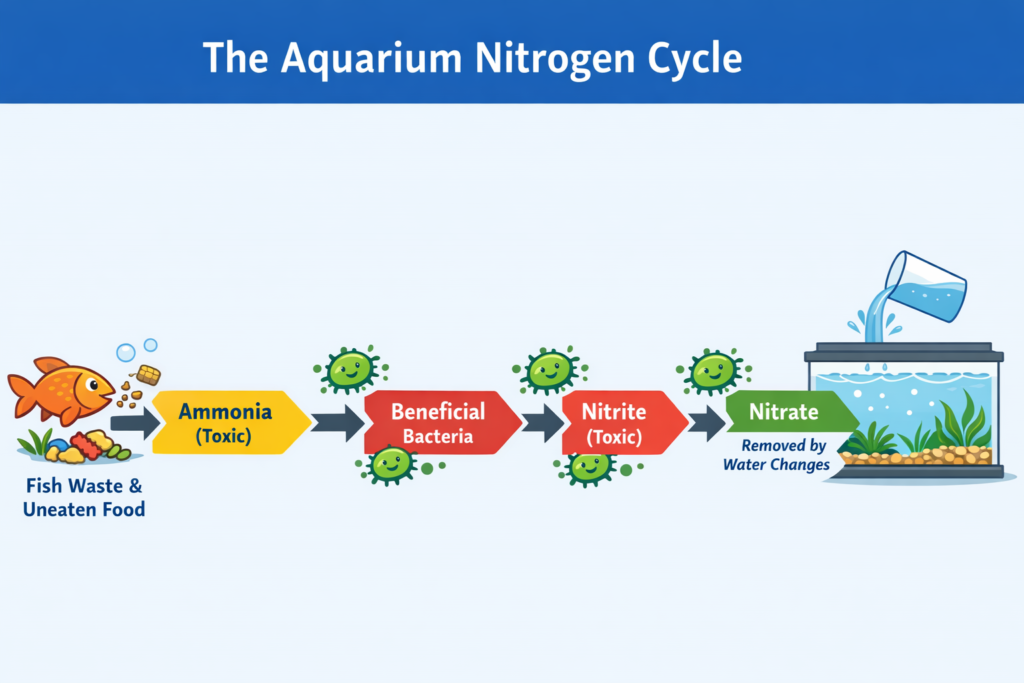
Stage 1: Ammonia Appears
Waste → Ammonia
Dead plants, leftover food, and fish waste all create ammonia.
- Goal: Ammonia = 0 ppm
Stage 2: Nitrite Appears
As ammonia builds, beneficial bacteria begin forming. These bacteria convert ammonia into nitrite, which is also toxic to fish.
- Goal: Nitrite = 0 ppm
Stage 3: Nitrate Appears
A second type of bacteria then grows and turns nitrite into nitrate.
Nitrate is far less harmful and is controlled with regular water changes.
- Goal: Keep nitrates below 20–40 ppm.
When you reach this stage and ammonia/nitrite both hit zero, your tank is cycled.
4. How Long Does the Nitrogen Cycle Take?
A normal cycle takes 2–4 weeks, but it can vary depending on:
- Tank size
- Filter type
- Temperature
- Whether you use bottled bacteria
- Whether you add an ammonia source
A warm tank with active filtration cycles faster.
5. How to Cycle Your Tank (Beginner Method)
Here’s the simplest way to start the cycle:
Step 1: Set up your tank
Add:
- Filter
- Heater
- Substrate
- Decorations
- Water conditioner
Let everything run.
Step 2: Add an ammonia source
You can use:
- A small pinch of fish food daily
- Liquid ammonia (fishless cycling)
- Bottled bacteria starter (optional but helpful)
This ammonia feeds the bacteria you’re trying to grow.
Step 3: Test your water regularly
Use a test kit to check for:
- Ammonia
- Nitrite
- Nitrate
You’ll see them rise and fall over time.
Step 4: Wait for ammonia and nitrite to hit ZERO
This means beneficial bacteria have fully established.
You must see:
- 0 ppm Ammonia
- 0 ppm Nitrite
- Some Nitrate present
Only then is the tank safe for fish.
6. How to Know When Your Tank Is Cycled
Your tank is cycled when:
- Ammonia stays at 0 ppm
- Nitrite stays at 0 ppm
- Nitrates show up and remain stable
- Your filter has visible biofilm or brownish bacteria growth (a good sign!)
At this point, you can slowly begin adding fish.
7. After Cycling: Add Fish Slowly
Even in a cycled tank, adding too many fish at once can overwhelm the bacteria colonies.
Start with just a few fish, wait a week or two, then gradually build your community.
Adding fish slowly allows your beneficial bacteria to adjust to the increased waste.
8. Common Mistakes to Avoid
Beginners often run into issues because they:
- Add fish too early
- Don’t test their water
- Clean the filter with tap water (kills bacteria)
- Overfeed
- Replace filter cartridges too often
- Do not use water conditioner
- Add too many fish at once
Avoiding these mistakes makes your tank much more stable.
Final Thoughts
The nitrogen cycle is the foundation of every healthy aquarium. Once you understand how it works, the rest of fishkeeping becomes much easier. Take your time, test your water, and be patient — your reward is a stable, thriving tank where your fish can live long and healthy lives.
If you’re setting up your first aquarium, cycling is the most important step you can master. With a little patience, you’ll be well on your way to a successful fishkeeping journey.